
If something didn’t change—and fast—I wasn’t going to make it to my forty-first birthday. I hadn’t taken a meaningful day off work in months. Going all-in, no brakes, was fun for a season: the feeling of adrenaline coursing through my veins as I made the final touches on a major project, moving miles a minute through obstacles that were no longer a problem. As a long-term strategy, this failed. Every time.
Sure, I’d taken plenty of personal and sick days along with holidays in the last year. But just because I wasn’t at the office didn’t mean I was resting. In the last three months alone, our family braved a dangerous ice storm; my husband had his last major surgery related to an unfortunate event from last year; we celebrated four years since Adoption Day for our daughter Gabby; my team survived Tax Day; I celebrated 13 years at my current company; and I launched my first book.
After the whirlwind was over, if I didn’t strategically step away, things would start to break down. The signs were already there. Allowing that to happen would be a costly and painful mistake. I was determined not to let it go there this time.
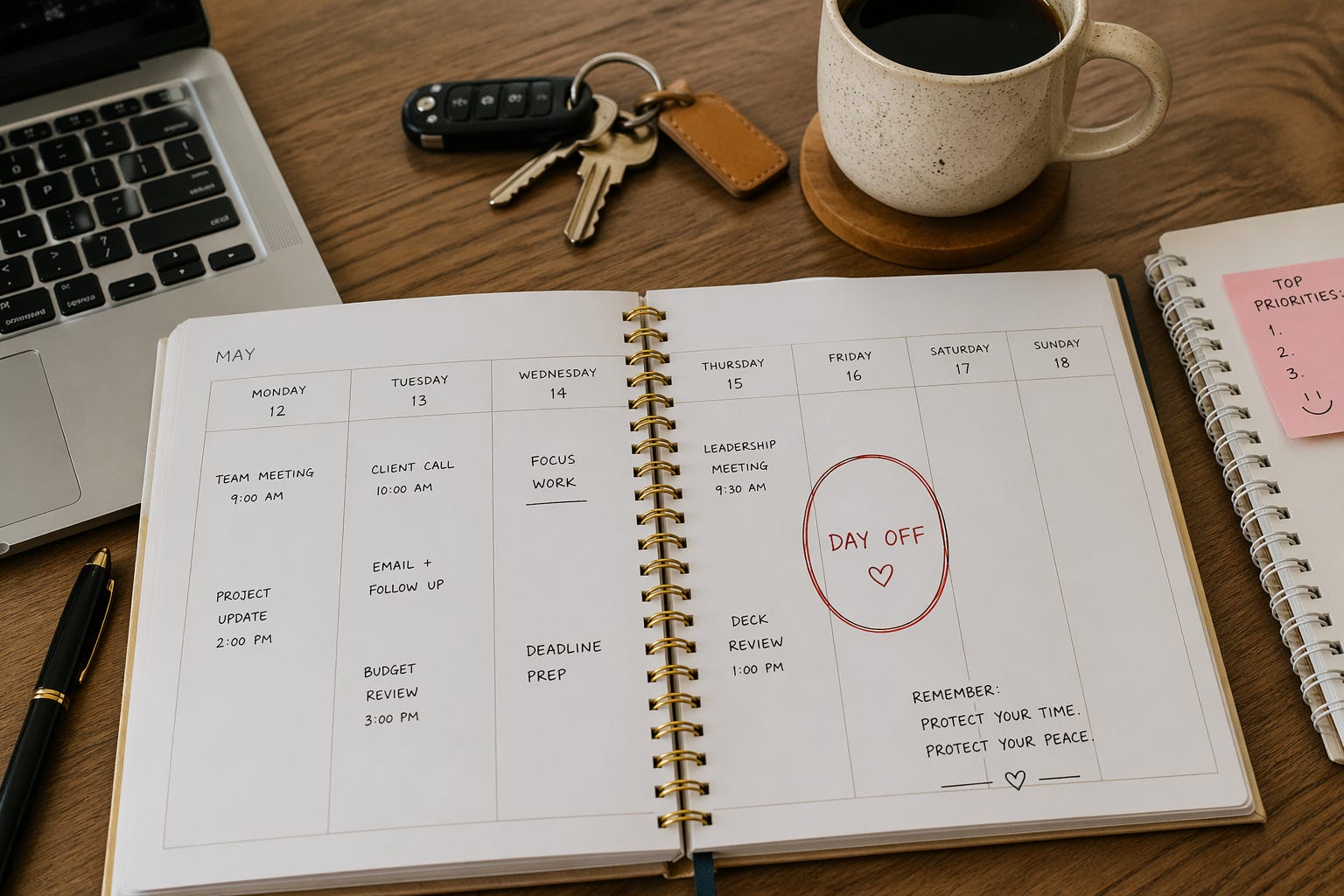
“Why don’t you take a day off?” my husband suggested. At first, the idea sounded too simple to work. A day away from the office wasn’t equivalent to a solution to burnout. But what could it look like to add intentionality behind some time off? Deciding to follow his advice was almost instant. What day would make sense? That’s when I nailed down the date: two days after Tax Day, I would step away.
But taking a day off wasn’t the hard part. Taking one intentionally was. I didn’t want a random Friday filled with errands, distractions, Netflix binging, or half-rest. I wanted to interrupt the rhythm I’d been living inside of long enough to remember what it felt like to be a person instead of a machine.
Expect things not to go as planned
Friday came, and all started according to plan… then my phone started blowing up.
All 35 members of my immediate family are taking a trip out East this summer to celebrate my parents’ fiftieth wedding anniversary. That’s too many people to squeeze into one rental, so we all coordinated short-term rentals to stay nearby. There will be group events throughout the week, but having almost three dozen humans in the same spaces will take some planning.
My family decided it would happen that day. The first day off I’d had in months. Perfect timing. Disruption rarely asks permission before arriving.
I turned the text thread and notifications off, and to solidify the decision, I turned all my electronics to “Do Not Disturb” mode. (Whoever invented that feature, Thank You!)
This day won’t be perfect, so it isn’t fair to expect it to be. Remember: the goal isn’t perfection; it’s disruption. If your normal rhythm is stress, speed, obligation, and reaction, then even a slightly imperfect day can still be wildly restorative.
Pick a day to step away
The minute you lock in the day, just know: invites will start rolling in. There will be conflicts galore. Protect that day. Don’t give in. Interrupting your rhythm will be worth it. Choose a day with intention. Don’t wait until burnout forces the decision for you.
Your body is usually polite before it becomes dramatic.
Plan ahead
Anything you can do beforehand, do it. Removing potential interrupters in advance will only help. The only person who knew how and where to find me that Friday was my husband. Accessibility is one of the biggest threats to rest. Constant availability trains your brain to stay alert, even when your body is technically off the clock. If everyone can reach you instantly, your brain never fully clocks out. Creating boundaries ahead of time isn’t selfish; it’s practical.
I get to work at 6:00 a.m., sometimes even arriving before the sun! I knew I wanted to stay up late the night before my day off, sleep in, yet still get up at a decent hour before the day slipped away entirely. I need 7-8 hours of sleep each night. If I stayed up till 1:00 a.m., I could get up at 8:00 a.m. and have squeezed in the bare minimum of sleep. That would give me just enough time to get ready for the day and head to my first venue by 8:30 a.m.
Note on the venue(s)… do your research. I lost some momentum during the two-hour writing retreat portion of my day while waiting in line for coffee (apparently, Friday mornings are when everyone has the same idea), trying to find the WiFi password (and utterly failing), and being distracted by the new venue. Don’t be like me. Choosing a familiar yet offsite enough venue can help.
Environment matters more than we admit. A change in scenery can shift your mindset, but unfamiliar places also come with friction. Strike a balance between “different enough to feel fresh” and “familiar enough to avoid wasting mental energy.”
The goal of this step is to clear your schedule and prime it for your Top Three.
This was the most important part of the entire day. Without intention, free time tends to disappear into scrolling, errands, chores, or vague productivity disguised as rest.
Ask yourself, “What do I want to feel like when this day is over?”
This question alone inspired the entirety of my day. I wanted to feel accomplished yet grateful and relaxed at the end of the day.
Establish your Top Three
If you can’t do anything else on the day you’ve chosen, what are the three things you want to have done that day? Think less about achievement and more about alignment. What would make the day feel worthwhile when it was over?
Here were mine…
Mini Writing Retreat | Time Elapsed: 2 hours; Venue: New Coffee Shop
Lunch with Family | Time Elapsed: 2 hours (commute + meal); Venue: A favorite Mexican Restaurant, at least 30 minutes away
Therapy or Relaxation | Time Elapsed: 1 hour (30-minute massage; 30-minute salt therapy session); Venue: Salted Peace
These weren’t extraordinary, and that’s the point.
Naps in excess of an hour count! Notice the order of events: therapy/relaxation was last. I’m glad I planned this for the end of the day. I arrived home relaxed, ready to tackle tasks, but still refused to do them… until the next day.
Part of breaking your rhythm means refusing to follow your usual script. My weekdays typically begin before sunrise, which meant sleeping in felt almost rebellious. That alone made the day feel different.
Nothing dramatic happened that Friday. No breakthrough. No life-changing revelation. Just a quiet interruption to a pattern that had been running unchecked for too long.
How did I actually feel when Friday was over?
Accomplished. Meaningful. Relaxed. In that order.
Sometimes the healthiest thing you can do is disrupt the rhythm that’s slowly wearing you down. Not everything in life needs to be maintained. Some patterns deserve to be broken.
If you want more stories like this, subscribe below. No noise, just writing that means something.
And if this piece stuck with you, share it with someone who might need it too.
I need a day like this!